
Key Points
- Microvascular Therapeutics, Inc., is developing proprietary microbubble technologies for diagnostic imaging and ultrasound-mediated therapies.
- Its therapeutic platforms are being designed to treat microvascular obstructions and enable nonthermal tumor ablation.

Microvascular Therapeutics, Inc. (MVT) is a clinical-stage biotechnology company developing proprietary microbubble and phase-shift microbubble (PSMB) technologies for diagnostic imaging and ultrasound-mediated therapies.
MVT’s lead product, CardiSon™, is in pivotal clinical development for contrast echocardiography. It is also developing two therapeutic platforms, Solv™ and NanoBlate™, to treat microvascular obstruction following heart attacks and to enable nonthermal tumor ablation. Finally, MVT is advancing ultrasound-mediated drug and gene delivery technologies.
We spoke with Emmanuelle J. Meuillet, PhD, chief scientific and operating officer, about MVT’s technology, development programs, and future opportunities.
Tell us about MVT and its origins.
MVT was founded in 2009 by Evan C. Unger, MD, a radiologist, serial biotechnology entrepreneur, and inventor of ultrasound contrast agents. The company became a C-corporation in 2023 and operates in Tucson, Arizona, with an additional presence in Salt Lake City, Utah.
Our leadership team has extensive experience in pharmaceutical development, regulatory approvals, ultrasound imaging, and commercialization. MVT also operates a specialized Current Good Manufacturing Practice (CGMP) manufacturing facility that is supporting clinical development and future commercialization.
What makes MVT’s technology unique?
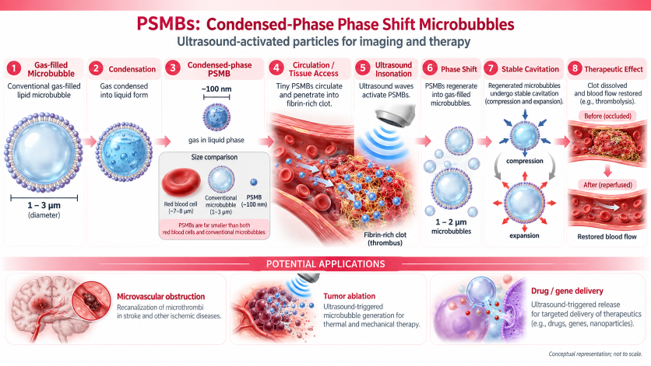
Our technology encompasses conventional gas-filled microbubbles and proprietary condensed-phase PSMBs. They are created by condensing the gas within microbubbles into its liquid phase, producing particles approximately 100 nanometers in diameter, much smaller than red blood cells or conventional microbubbles. Their small size enables penetration into thrombi and potentially other tissues that conventional microbubbles cannot readily access.
When exposed to ultrasound (insonation), PSMBs undergo a phase transition, regenerating gas-filled microbubbles at the target site. These microbubbles can oscillate in response to ultrasound, producing mechanical effects that can be harnessed for thrombus disruption, tumor ablation, and targeted therapeutic delivery. The ability to deliver small, condensed-phase particles and subsequently activate them with ultrasound is a central advantage of MVT’s platform.
What is the status of your clinical programs?
Our lead product, CardiSon™ (also called MVT-100), is an investigational ultrasound contrast agent designed to improve cardiac imaging. In a Phase II clinical study comparing CardiSon with Definity®, CardiSon demonstrated improved left ventricular opacification and endocardial border delineation, with reduced acoustic shadowing.
CardiSon is now in pivotal clinical development, with an anticipated regulatory submission in 2027 and potential US commercialization in 2028, subject to successful trials and regulatory approval. CardiSon offers several practical advantages, including room-temperature storage and extended stability after activation.
How is MVT applying PSMBs to cardiovascular diseases?
Our Solv™ (also called MVT-101) program is designed to treat microvascular obstruction, which can persist following successful coronary artery reopening in patients experiencing ST-elevation myocardial infarction. Solv PSMBs are designed to penetrate microvascular thrombi and, following ultrasound activation, convert into gas-filled microbubbles that undergo cavitation and promote thrombus disruption.
In preclinical porcine studies, Solv improved myocardial perfusion and cardiac function and reduced measures of infarct injury compared with conventional microbubbles and untreated controls. We believe this technology has the potential to address an important unmet need in cardiovascular medicine.
How is MVT using focused ultrasound to treat cancer?
Our NanoBlate™ platform combines PSMBs with focused ultrasound to produce mechanical, nonthermal tumor disruption. In collaboration with researchers at the University of Utah, including Henrik Odéen, PhD, MS, we have demonstrated tumor ablation in preclinical intracranial glioblastoma models. Unlike conventional thermal focused ultrasound ablation, this approach is designed to mechanically disrupt tumor tissue while limiting thermal injury to surrounding structures. We are initially focusing on brain tumors, with the potential to expand into other solid tumors.
Are there additional applications for your technology?
Yes. We are developing PSMB and microbubble technologies for ultrasound-mediated delivery of therapeutic agents, including nucleic acids, plasmid DNA, and other biologic payloads. Our research includes blood-brain barrier opening and the potential to deliver therapeutic agents to otherwise difficult-to-access tissues. These applications could create opportunities across oncology, neurodegenerative diseases, and gene therapy.
Do you collaborate with academic institutions and industry partners?
Collaboration is central to our strategy. We work with academic researchers and commercial partners, including teams at the Universities of Pittsburgh, Utah, and Arizona. We have also enjoyed participating in the Focused Ultrasound Foundation’s industry internship program over the past two years. The students have made valuable contributions, and the Foundation has been an excellent partner in identifying talented young scientists.
What is your long-term vision?
Our goal is to establish MVT’s microbubble and PSMB technologies as versatile platforms for ultrasound-mediated diagnosis and therapy. With CardiSon advancing through pivotal clinical development and Solv, NanoBlate, and our gene delivery programs progressing preclinically, we see significant opportunities to expand the therapeutic potential of ultrasound. We believe the combination of proprietary phase-shift technology and precisely targeted ultrasound could enable an entirely new generation of minimally invasive therapies.
Learn more: www.mvtpharma.com