
Key Points
- A doctoral student in the Ultrasonics Group at University College London recently published the project that he completed while participating in the Foundation’s Global Internship Program.
- He developed a novel approach for characterizing acoustic cavitation.
Max Au-Yeung, MEng, who is now a doctoral student being mentored by Reza Haqshenas, PhD, in the Department of Mechanical Engineering at University College London (UCL), recently published the project that he completed while participating in the Foundation’s Global Internship Program.* UCL was named a Focused Ultrasound Center of Excellence earlier this year.
Acoustic cavitation occurs when focused ultrasound causes tiny bubbles to form, oscillate and collapse in tissues. Detecting and monitoring acoustic cavitation are essential when using focused ultrasound; doing so helps with ensuring safety and confirming efficacy across applications ranging from hyperthermia, thermal ablation, and histotripsy, to drug/gene delivery, and blood-brain barrier opening.
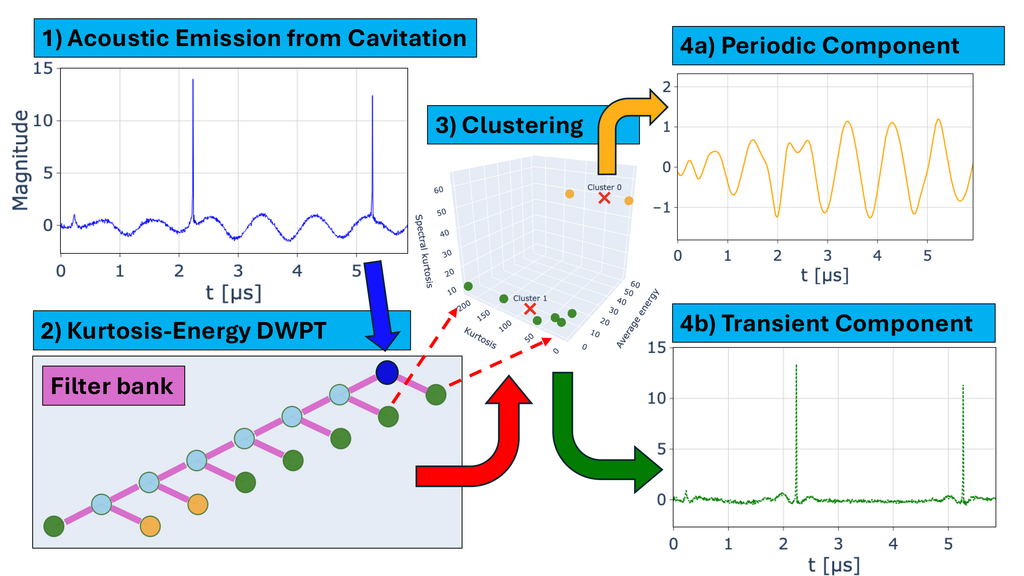
To improve on current acoustic cavitation monitoring methods, the UCL team worked to develop a new approach that isolates and analyzes the statistically distinct components of the acoustic emissions (i.e., the fundamental, harmonics, sub-harmonics, ultra-harmonics, broadband component, and measurement noise) recorded during cavitation. They were able to successfully use a series of mathematical and engineering tools –discrete wavelet packet transform, statistical signal processing, and k-means clustering – to separate, quantify, and classify the cavitation features in acoustic emissions. This method could allow for improved identification and quantitative characterization of both transient and periodic features in acoustic emissions.
“What began as a summer internship project has grown into the starting point of my PhD,” said Mr. Au-Yeung. “Cavitation produces complex acoustic emissions, from harmonics to broadband noise, that are difficult to interpret consistently. By decomposing these signals into their distinct components and quantifying them objectively, we hope to make cavitation monitoring more reliable and help enable better-controlled focused ultrasound treatments. I’m very grateful to the Focused Ultrasound Foundation for giving me that first opportunity.”
The new method is described fully in the publication, and the code is openly available online on a GitHub repository.
See Applied Acoustics (Open Access)
*The Foundation’s Global Intern Program provides high school and undergraduate university students with an opportunity to participate in focused ultrasound research through a summer internship with an academic researcher or industry mentor at recognized focused ultrasound sites around the world. Applications for the Foundation’s 2027 Global Intern Program will open early next year. Join our newsletter email list to be notified.
Related Stories
Focused Ultrasound Foundation Designates University College London and King’s College London as a Focused Ultrasound Center of Excellence January 2026
Foundation Recognizes Outstanding 2024 Global Interns November 2024